
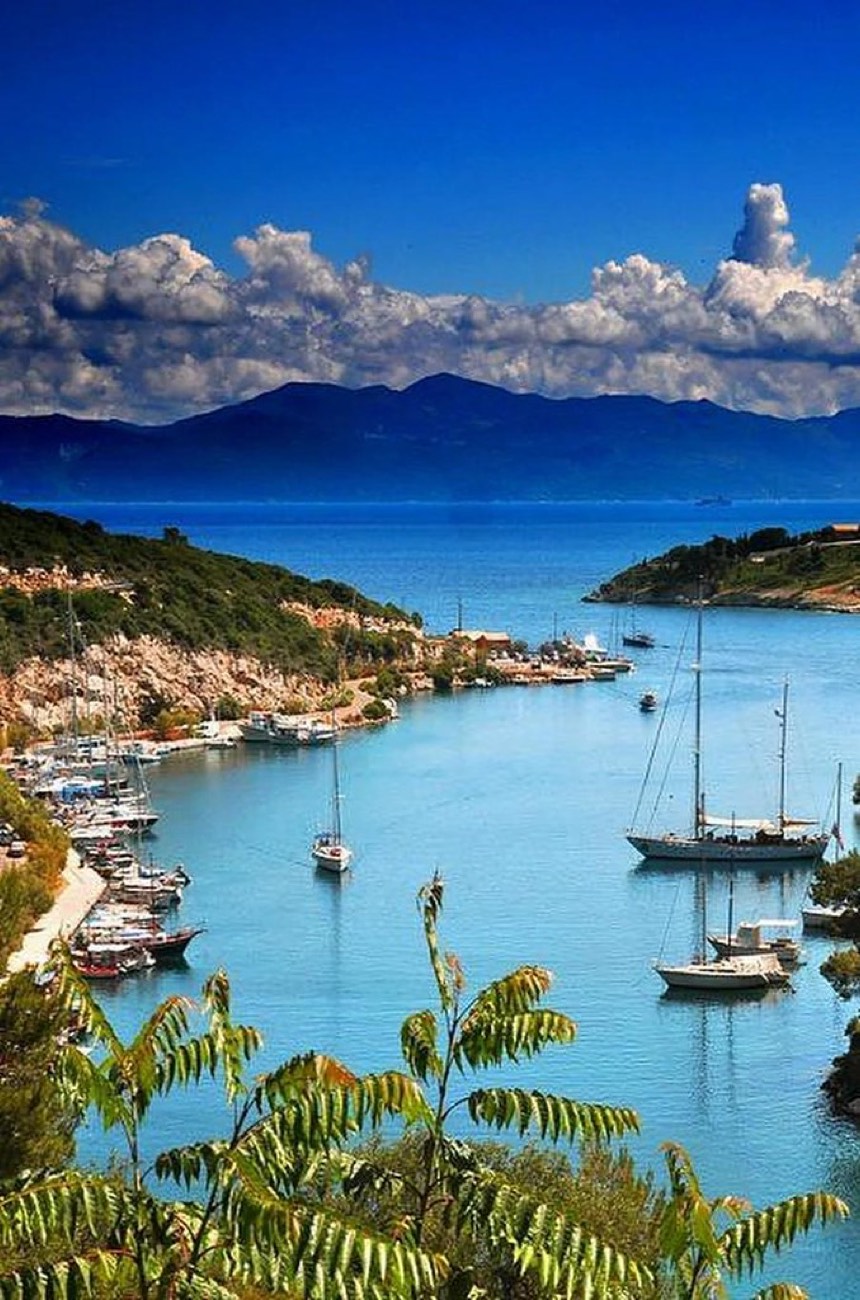
Some days out do not need much explaining, and a crossing to Paxos and Antipaxos is one of them. Around eleven nautical miles south of Parga, across open Ionian water, this pair of islands packs harbour villages, silvered olive hills and two of the most photographed coves in Greece into a single, comfortably paced day. It is the classic excursion from this stretch of the Epirus coast, and for good reason.
Getting there: the crossing from Parga
Day-trip boats leave Parga's harbour in the morning, typically somewhere around nine or ten o'clock, for a crossing that takes about an hour to reach Paxos itself, or a little longer, closer to seventy or seventy-five minutes, if the first call is Antipaxos. Most itineraries run as a loop: out across open water, a swim stop at Antipaxos, a look at the Blue Caves on Paxos's western cliffs, then into the harbour at Gaios for lunch and a wander before the return leg. A full day out typically runs to somewhere between seven and nine hours door to door. Because the route crosses open sea rather than hugging the coastline, a settled forecast matters more here than on shorter trips, and schedules can shift at short notice if conditions are poor.
Antipaxos: Voutoumi and Vrika
Antipaxos is tiny, scarcely five square kilometres, and largely given over to vineyards rather than houses, but it produces the single most vivid stretch of coastline on this trip. Its two beaches, Voutoumi and Vrika, sit on the north coast and are usually the first stop of the day, reached either directly by the day-trip boat or by a short local crossing from Gaios. Voutoumi is the larger of the two: a curved bay of pale pebble and fine sand shelving into water that runs through every shade of turquoise and indigo, framed by pine-covered slopes. Vrika, a little further along, is sandier and shallower, which makes it the better choice for children or hesitant swimmers. A concrete path links the two, a walk of around half an hour with a modest climb in the middle and sea views along most of it, so it is possible to see both in one visit if the boat schedule allows. Sunbeds and simple refreshments are available at each in season, though shade is limited, so a hat and plenty of water are worth packing.
Gaios: the harbour town
Back across the strait, Gaios is the capital of Paxos and the heart of most day trips. Its harbour is a genuinely handsome sight: a curve of pink, ochre and white houses facing a narrow channel, with the small islet of Agios Nikolaos sitting in the middle like a natural breakwater. Boats moor along the quay, and the waterfront behind them is lined with seafront tavernas, small shops and shaded lanes climbing into the town, enough for an hour or two of lunch and wandering before the return crossing. On the way to or from Gaios, many boats swing past the Blue Caves on the island's western coast, a series of sea caverns cut into pale limestone cliffs near Erimitis, where the water takes on an almost luminous blue in the right light.
Lakka and Loggos: two quieter moods
If a particular itinerary allows more time on Paxos itself, it is worth knowing that Gaios is only one of three harbour villages. Loggos, on the east coast between Gaios and Lakka, is the smallest and sleepiest of the three, a tight cluster of fishermen's houses around a small square harbour. Lakka, at the island's northern tip, wraps around a wide horseshoe bay that has long drawn sailing boats, and has a more open, breezy character than Gaios's sheltered channel. Not every day trip calls at either village, so it is worth checking the plan in advance if seeing beyond the capital matters to you.
Olive groves and island character
Away from the water, Paxos is a green, hilly island, and almost all of that green is olive. Terraced groves climb the hillsides in every direction, and local tradition traces many of them back to the period of Venetian rule, which lasted here from the late fourteenth century until the end of the eighteenth century; islanders are said to have been encouraged, even required, to plant trees during those centuries, which is part of why so many of Paxos's olives are genuinely old, gnarled specimens rather than recent plantings. The oil produced here has a long-standing local reputation, and small producers still press it by traditional methods. Antipaxos, by contrast, is given over largely to vines, and its wine, made in small quantities, rarely travels far beyond the island itself.
Good to know
- Crossing time from Parga is roughly one hour to Paxos, and about seventy minutes to Antipaxos direct.
- A full day trip typically runs seven to nine hours in total, including all stops.
- Sea conditions can affect the schedule, since the route crosses open water; check on the morning if in doubt.
- Shade is limited on Antipaxos's beaches, so bring a hat, sun cream and water.
- The walk between Voutoumi and Vrika takes about thirty minutes and includes some uphill sections.
- Not all itineraries include Lakka or Loggos; ask in advance if you would like to see them.
- Cash is useful in the smaller villages, where card payment is not always available.