
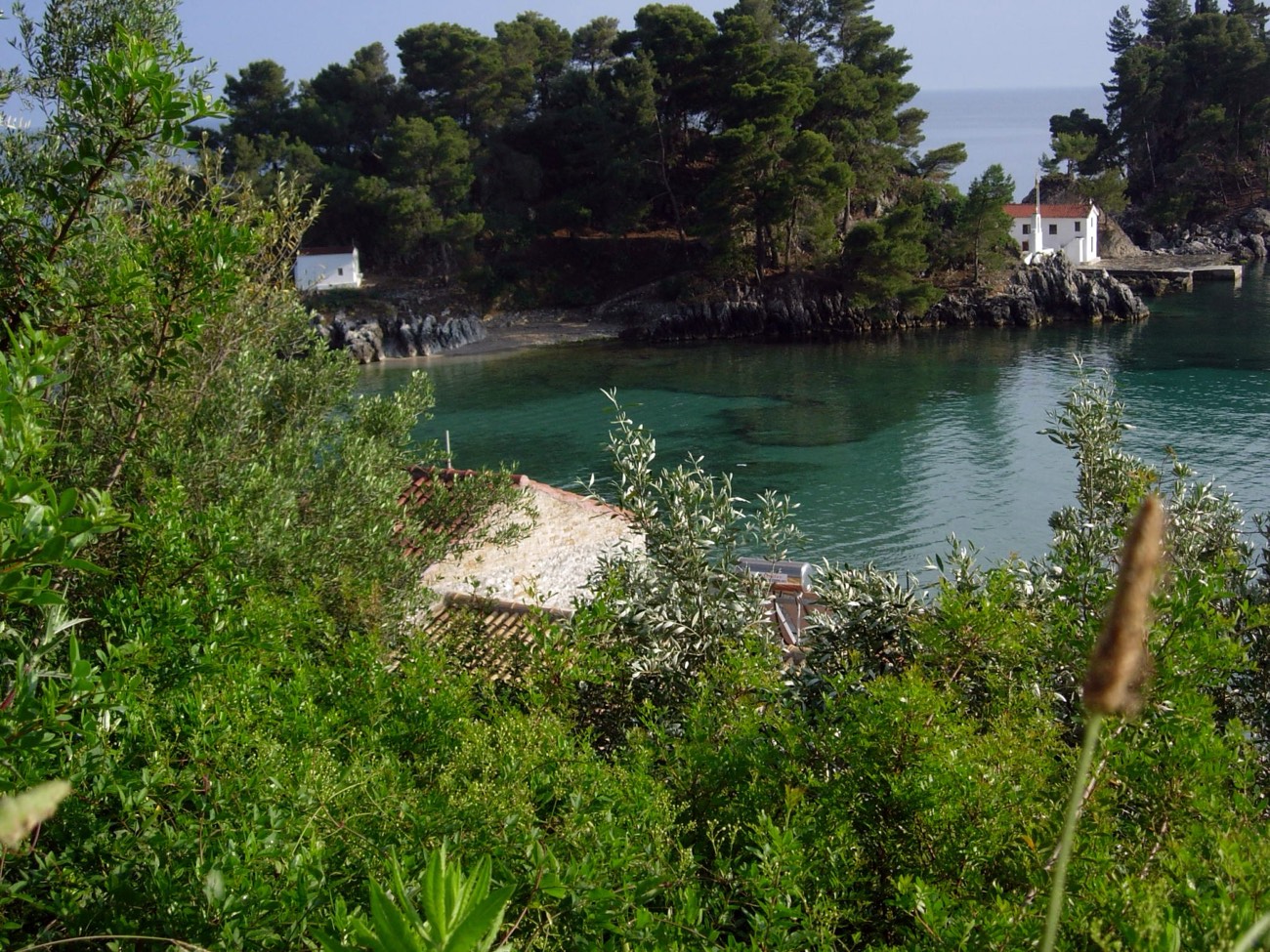
Stand anywhere along Parga's town beach and your eye is drawn to the same small shape: a green, rocky islet a short way offshore, topped by a whitewashed chapel and a slender bell tower. This is the islet of the Panagia — the Virgin Mary — and though it is barely a stone's throw from the sand, it has become the single image most people carry home from Parga. Together with the Venetian castle on the hill above the town, it is what the place looks like in the memory.
The church that named an island
The islet takes its name from the little Greek Orthodox church built upon it, dedicated to the Koimisis tis Theotokou — the Dormition, or falling-asleep, of the Mother of God. It is a modest whitewashed chapel with a picturesque steeple, the kind you find on rocky outcrops all along the Greek coast, where seafarers have long placed themselves under the Virgin's protection.
There is nothing grand about it, and that is rather the point. Its charm lies in the setting: the deep green of the pines and shrubs, the pale walls catching the afternoon light, and the Ionian shimmering all around. Photographers love it at either end of the day, when the colours soften and the water turns glassy.
The little fort at the top
Climb the islet and you will find, at its highest point, the remains of a small fort built by the French in 1808. During their occupation of the wider region in the Napoleonic era — the French held this stretch of coast on and off between 1797 and 1814 — they threw up this modest gun position to watch over the corner of the bay and its small craft, a slice of water that could not be easily covered from the great Venetian castle on the town's headland. A carved inscription over the doorway still reads Défense de la Patrie — "defence of the homeland" — beside the date. The chapel sits just below these old walls, so faith and fortification share the same small rock.
Local lore adds a modern footnote: the shipping magnate Aristotle Onassis is said to have admired the islet and enquired about buying it, even, so the story goes, planning to rename it after his daughter Christina. Whether or not the tale is strictly true, it is the kind of thing Pargans tell with a smile — proof that this little green rock has always turned heads.
Swimming or paddling across
The best part is that you can reach it under your own steam. The islet lies only around a hundred metres off the main town beach at Krioneri, and on a calm summer's day it makes for a lovely, unhurried swim — a matter of minutes for a confident swimmer, and longer if you take it gently, with the chapel growing larger stroke by stroke. You needn't be a strong swimmer, but do keep an eye on passing boats and pick a quiet moment away from the harbour traffic.
If you would rather stay dry, a pedalo or kayak hired from the beach will get you there in minutes, and small local boat trips pass close by throughout the day. However you arrive, the landing is rocky rather than sandy, so a pair of water shoes is worth their weight — they save tender feet both getting out of the water and scrambling up towards the chapel.
It is a genuinely family-friendly outing in settled weather, and children tend to treat the crossing as a small adventure. That said, there are no facilities on the islet — no shade to speak of beyond the trees, no kiosk, no lifeguard — so treat it as a short, self-sufficient excursion rather than a place to spend the whole day.
The feast of the Panagia
The islet comes into its own on 15 August, the feast of the Dormition of the Virgin and one of the most important days in the Greek calendar. Boats ferry the faithful across the short stretch of water, the little church is filled beyond its tiny capacity, and the celebration spills out onto the rock and back into the town. If you are in Parga in mid-August, it is a moving thing to witness.
The setting is romantic enough that couples sometimes choose the chapel for their weddings, the bride crossing to the islet by boat. On any ordinary summer evening, plenty of visitors are content simply to swim out, sit for a while by the walls, and watch the town light up across the water.
Why it is the emblem of Parga
Parga likes to think of itself as an "island town", strung between its Venetian fortress, its amphitheatre of pastel houses and its sheltered bay. The Panagia islet gathers all of that into one small, perfect frame: a fragment of history, a working chapel, and a swim you can make on a whim. It asks almost nothing of you — a hundred metres of calm water — and gives back the postcard you will remember. That is why, of all Parga's sights, this little church in the bay has become its emblem.
Good to know
- Getting there: a roughly hundred-metre swim from the town beach at Krioneri, or a few minutes by pedalo, kayak or local boat.
- Wear water shoes: the shoreline and landing are rocky.
- Best time: calm mornings for a quiet swim; late afternoon and sunset for photographs.
- Facilities: none on the islet — carry water and a hat, and mind your footing on the climb.
- Safety: watch for boat traffic and only swim across in settled conditions.
- Feast day: 15 August (Dormition of the Virgin) brings crowds, boats and celebration.