
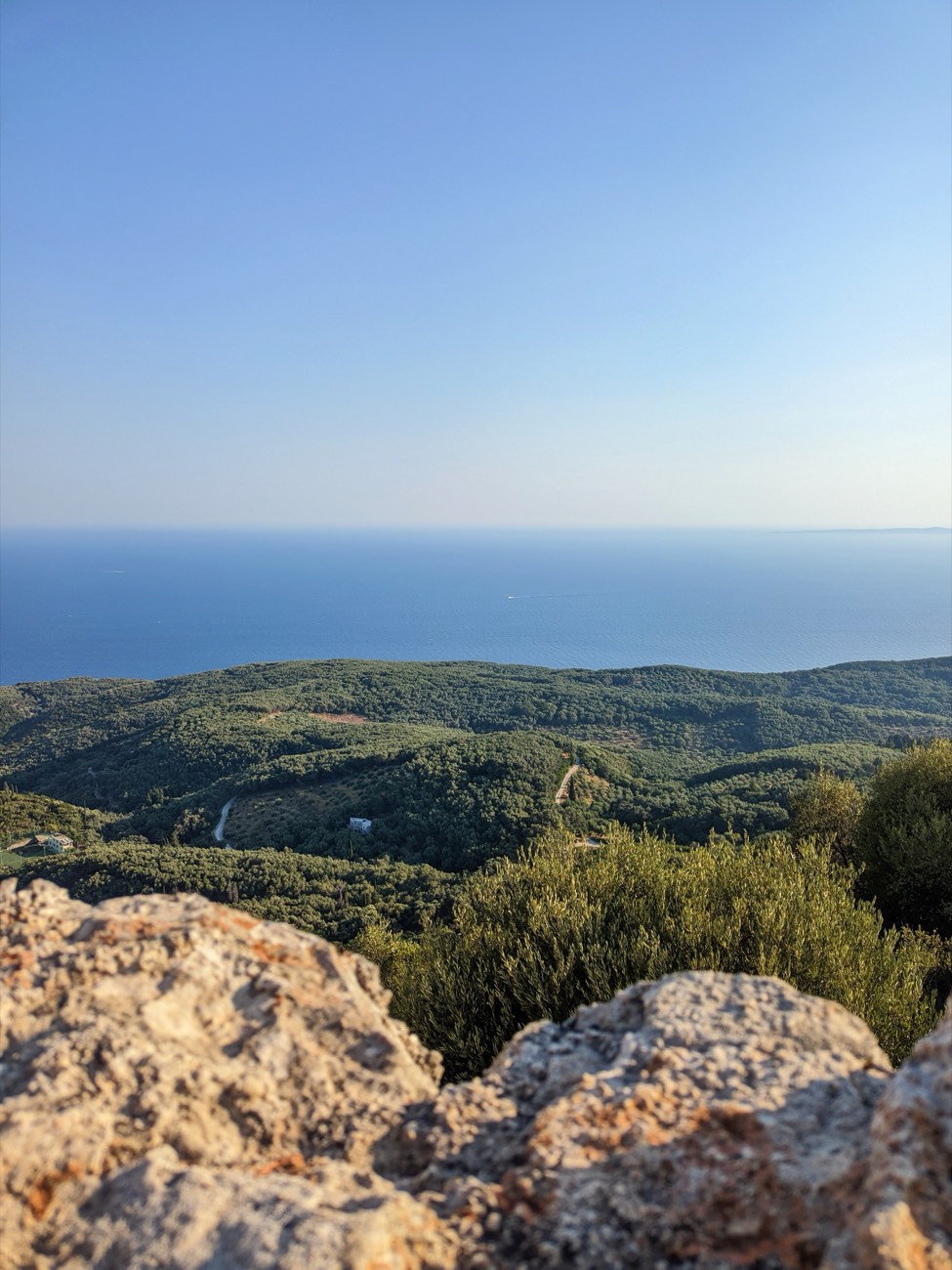
Fly into Preveza or drive down from Igoumenitsa and, long before you reach the sea, you will notice the trees. They cover every fold of hillside around Parga in soft, silvery green — gnarled trunks, low canopies, terraces stepping down towards the water. The beaches and the Venetian castle draw the eye first, but it is the olive that has shaped this stretch of Epirus for longer than almost anything else. To understand Parga, it helps to understand its groves.
A coastline wrapped in silver and green
Parga itself is built amphitheatrically on a hillside thick with olive trees, its pastel houses tucked between branches that lean towards the bay. Move a few kilometres inland and the pattern intensifies: the villages of Anthousa, Agia and Trikorfo sit among plateaus and slopes where olive terraces have been cut into the land for generations, following the contours the way rice terraces follow a valley in other parts of the world. Some of the trees are genuinely old — thick-waisted, hollowed, still fruiting after a century or more — standing alongside younger plantings in the same groves.
Roots going back centuries
The scale of cultivation here has a documented history. Parga came under Venetian rule in 1401, at the start of the fifteenth century, and remained largely under Venetian control for close to four hundred years. During that long period, the Venetians built the town's fortress and planted large numbers of olive trees across the surrounding land, turning Parga into a working centre of the olive oil trade along this coast. That agricultural backbone never really disappeared. Long after Venetian rule ended in the late eighteenth century, the groves endured through the region's later upheavals — a period of Ottoman-era administration, the displacement and gradual return of local families through the nineteenth century, and Epirus's incorporation into the modern Greek state in the early twentieth century — and they remain tended today, when olive oil is still one of the area's principal products.
The rhythm of the harvest
The olive calendar dictates a good deal of rural life in Epirus. Trees flower in late spring, the fruit develops through summer, and picking generally runs from November into December, sometimes stretching into January depending on the weather and the variety. Among the varieties grown across Epirus, including in the Preveza and Thesprotia areas near Parga, is a small, fruity type called lianolia, prized for producing a mild oil with a notably high phenolic content — one of the qualities that makes good Epirot oil stand out.
Harvesting methods have changed less than you might expect. Long nets are still spread beneath the trees, and pickers work the branches by hand or with light rakes, combing the olives free rather than stripping the tree roughly. Whole families turn out for it, often several generations at once, moving grove to grove over consecutive weekends. The picked fruit is taken to a press quickly, usually within a day, since speed between tree and mill matters enormously for the quality of the finished oil — a principle that holds whether the pressing happens by traditional stone wheel or, as is now more common, modern cold-press machinery.
Oil at the heart of the table
None of this agricultural effort is abstract once you sit down to eat in Parga. Olive oil here is not a garnish but a foundation — used generously in cooking, then often added again, raw, once a dish is off the heat, to bring out its aroma. Wild greens dressed simply with oil and lemon, slow-cooked beans, grilled fish, and the ubiquitous village salad all lean on it. Table olives themselves, cured in brine or dry-salted, turn up as a starting point for almost any meal, and small jars or tins of local oil make an obvious, practical souvenir, sold by growers and shops around the town and in the hill villages.
Walking and visiting among the groves
Getting a proper feel for the groves is easy without a car, though a short drive opens up more ground. Anthousa sits around three kilometres north-west of Parga, on higher ground inland, and can be reached on foot via a fairly long, steady uphill walk of around an hour, or by a drive of about ten minutes. Agia, the largest of the nearby villages, lies roughly six to seven kilometres north of Parga, with Trikorfo close by in the same cluster of hill settlements; both make an easy short drive further into the hills. Paths thread between the terraces in several places, giving walkers views back over the rooftops of Parga towards Paxoi and Antipaxos on a clear day. If you visit during harvest weeks in late autumn, you may well see families at work in the groves — a genuine slice of local life rather than a display, so it is worth admiring from the path rather than wandering into private land.
- Best time to see the harvest: late November into December, occasionally running into January.
- Nearby villages worth the trip: Anthousa (closest, reachable on foot or by a short drive), Agia and Trikorfo (a short drive further into the hills).
- What to wear: sturdy, grippy shoes — grove paths and terraces are often uneven, stony or muddy after rain.
- Buying oil: small local producers sell direct from farms or village shops; look for this-year's harvest date on the label.
- Etiquette: groves are working farms and private land, even where paths run close by — stick to marked routes, especially during picking season.
Long after the last day-trip boat has left the bay for the evening, the olive groves are still there, quietly doing what they have done around Parga for over six hundred years — holding the hillsides together, feeding the table, and giving this small corner of Epirus its unmistakable green.