
Easter, or Pascha, is the most important date on the Greek Orthodox calendar, and in a small coastal town like Parga it is felt rather than performed. There are no crowds bussed in for the occasion, no staged spectacle — just parish life unfolding as it has for generations, with the added, particular weight of a date that means something specific to this town's own history. For visitors who happen to be here during Holy Week, it is worth understanding what is taking place, and why it is watched quietly rather than photographed loudly.
A week of mourning before the feast
Holy Week (Megali Evdomada) begins on Palm Sunday, but it is from Holy Monday onwards that the rhythm of the town changes. Church services lengthen each evening, fasting intensifies in observant households, and the mood turns inward. By Holy Thursday, kitchens across Parga are dyeing eggs a deep red, symbolic of the blood of Christ, and baking the sweet, plaited bread known as tsoureki. In church that evening, the reading of the Twelve Gospels recounts the Passion in full, and by its end the building is dressed in black and purple, its icons veiled, its atmosphere entirely changed from the ordinary Sunday liturgy.
Good Friday: the Epitaphios, and a date Parga knows well
Good Friday is the most solemn day of the Orthodox year. Church bells do not ring in celebration but toll slowly and mournfully throughout the day. In the afternoon, parishioners traditionally gather to decorate the Epitaphios — a bier representing the tomb of Christ — with flowers, often working in near silence. By evening, the flower-covered bier is carried out of the church and through the streets in procession, followed by the priest and the congregation holding lit candles, the town's ordinary evening sounds replaced by chanting and slow footsteps.
For Parga, Good Friday carries a second, entirely local weight. It was on Good Friday 1819 that the town's own exodus began. Parga had been under British protection, and under a convention with the Ottoman Empire signed in 1817 and ratified by the Sultan in 1819, Britain agreed to cede the town to Ali Pasha of Ioannina — a decision that stunned a population unwilling to live under his rule. Rather than remain, most of Parga's people chose to leave. Accounts describe them digging up the bones of their ancestors from the town's cemeteries and burning them, then carrying the ashes down to the harbour along with their icons, their flags, and handfuls of soil from their homeland, sailing into exile in British-held Corfu. That the bells tolled that day for both reasons — the Passion of Christ and the town's own departure — is not lost on Parga today, and it is part of why Good Friday here is marked with particular gravity.
Holy Saturday and the midnight Resurrection
Holy Saturday is a quiet day of preparation, often with a brief morning service known as the First Resurrection. The main event comes at night. Shortly before midnight, the church is darkened and the congregation gathers holding unlit candles. The priest emerges with a flame traditionally said to be lit from the Holy Fire in Jerusalem, passing it candle to candle through the church and out into the crowd gathered outside. At the stroke of midnight, the announcement rings out — Christos Anesti, "Christ is risen" — bells sound, and fireworks or firecrackers often crack over the town. People walk home carefully shielding their flame, some pausing to mark a small sooty cross above their front door for the year ahead.
Easter Sunday: the table reopens
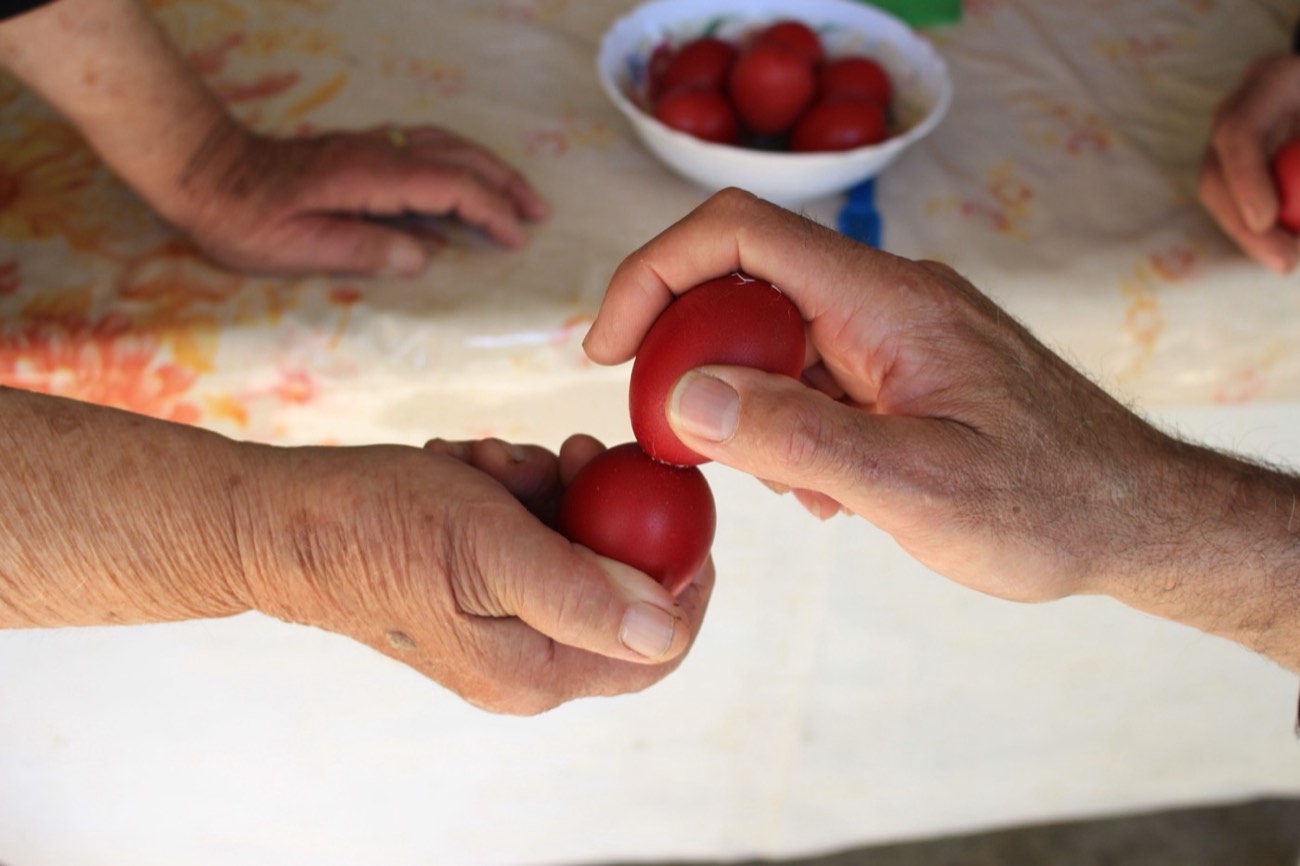
After the midnight service, families traditionally return home to break the Lenten fast with magiritsa, a soup made from lamb offal and herbs, together with the red eggs cracked in the game of tsougrisma, where each person tries to be the last with an unbroken shell. The larger feast comes at midday on Easter Sunday itself, centred on a whole lamb slow-roasted on a spit, often alongside kokoretsi. In Parga and other Epirus communities, the day tends to stretch into music and dancing as families reunite, some returning from Athens or further afield specifically for the holiday.
Good to know
- Orthodox Easter follows the Julian calendar and often falls later than Western Easter — sometimes by a few weeks, occasionally on the same weekend. It is worth checking the date for the specific year of a visit.
- The Good Friday procession typically sets off from the church in early evening; asking locally on the day is more reliable than any fixed timetable.
- Dress modestly if attending a service — covered shoulders and knees are appreciated.
- Many shops and other small businesses close or reduce their hours around Good Friday and Easter Sunday, as staff spend the holiday with family.
- Visitors are welcome to observe the processions from the roadside, but this is a religious rite for the local community rather than a display for onlookers — quiet, respectful attendance is appropriate, and flash photography is best avoided.
- The town feels noticeably different during Holy Week compared with summer: quieter, more local, and largely unconcerned with the tourist calendar.