
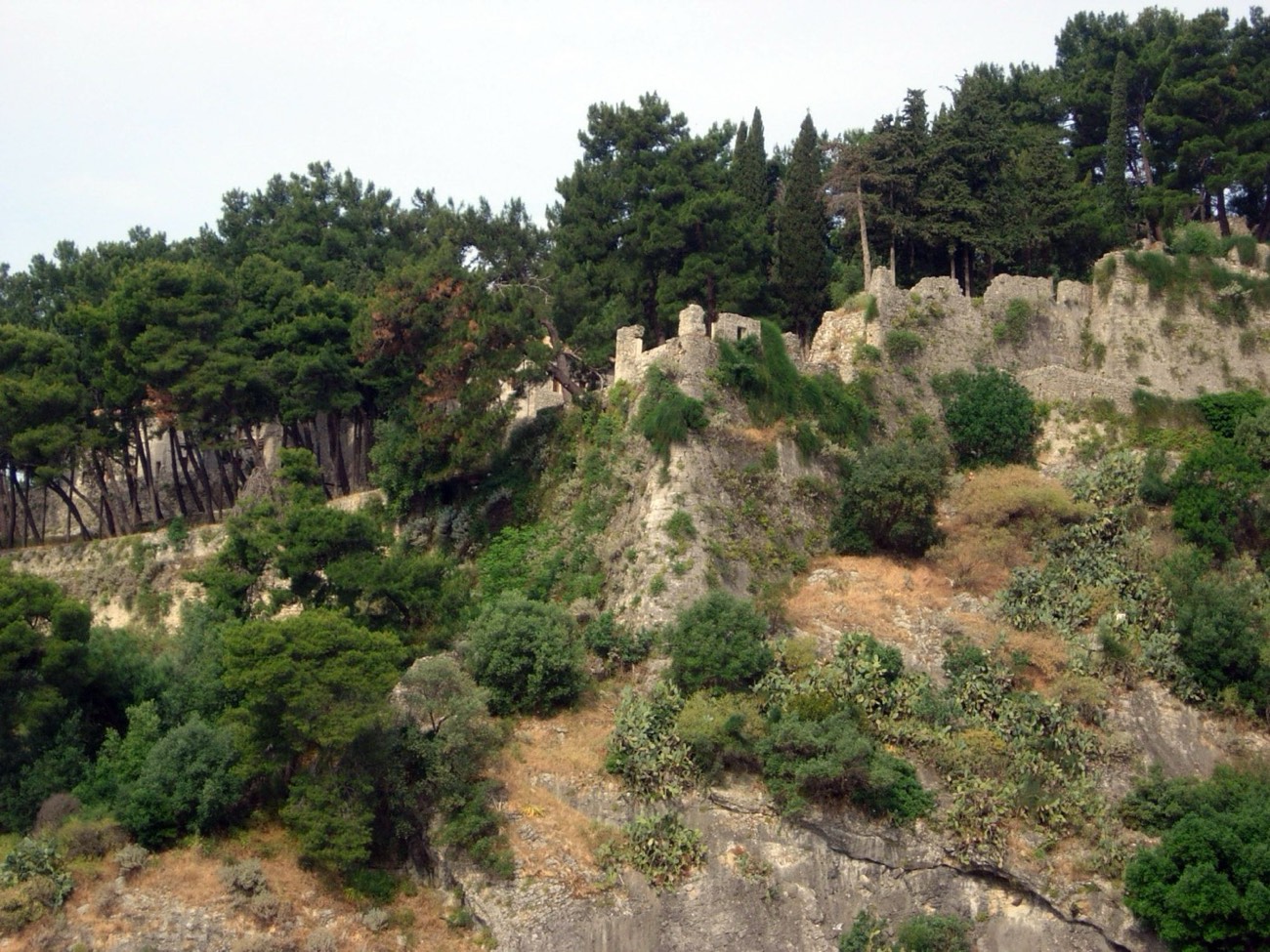
Wherever you wander in Parga's old town — along the harbour, through the tangle of stepped lanes, out onto the pebbles of the town beach — the castle is there above you, crowning the pine-clad headland that divides the bay. It has watched over the town for the best part of a thousand years, and a slow walk up to its ramparts remains one of the most rewarding things you can do here, as much for the history underfoot as for the view that opens at the top.
Centuries of sieges and rebuilding
The first fortifications on this rock were raised in the 11th century by the people of Parga, who needed a refuge from the pirates and raiders that plagued this coast. In 1401 the town passed under Venetian control, and was administered as a mainland exclave of Venice's great island possession of Corfu, just across the water.
What you see today is not one castle but the last of several. The stronghold was fought over, burned and demolished more than once — the Ottoman admiral Hayreddin Barbarossa razed it in 1537 — and each time it rose again from the same rock. The Venetians began the third and definitive fortress in 1792, and the work was completed around 1808 by the French, who held this stretch of coast in the years after the fall of the Venetian Republic.
Ali Pasha and the exodus
No figure looms larger over Parga's later history than Ali Pasha of Ioannina, the ambitious Ottoman-Albanian governor who coveted the town for decades. Despite repeated sieges the castle held firm, until politics achieved what cannon could not: in 1819 the British, then in control of the town, handed Parga over to Ali Pasha. Rather than live under his rule, almost the entire population gathered up the bones of their ancestors and sailed away to Corfu — one of the most poignant episodes in the region's history, and one still remembered here.
Ali Pasha left his own mark on the walls, strengthening the defences and adding a hammam and quarters of his own within the citadel. His emblems and inscriptions can still be picked out in the stonework as you explore.
What you'll see today
Entry is free, and the gate itself is the first thing worth pausing over. Above the archway, the winged Lion of Saint Mark — the emblem of Venice — is still carved into the wall, set among old inscriptions and Ali Pasha's own emblems: a small stone summary of everyone who once held the place.
Inside, the ground rises in terraces of weathered masonry — vaulted passageways, gun emplacements and bastions, old barracks and storerooms — all softened now by wildflowers and the shade of pine and cypress. Modern buildings in the central area host exhibitions and open-air performances through the summer, and there is a small café within the walls if you would like to linger over a cold drink.
The view from the top
Climb to the highest bastion and the whole of Parga lays itself out beneath you. On one side, the long golden sweep of Valtos beach curls away below the walls; on the other, the harbour, the terracotta rooftops of the old town and the little islet of Panagia with its chapel, marooned in a turquoise bay. Beyond it stretches the open Ionian, and on a clear day you can pick out the low profile of Paxos on the horizon. It is, quite simply, one of the finest vantage points in town.
Come in the early morning for cool air and soft light, or in the late afternoon, when the sinking sun gilds the rooftops and the water — the classic hour for photographs, and for watching the day fade over the sea.
Walking up from the old town
Reaching the castle is half the pleasure. From the centre of the old town, a cobbled, stepped street climbs steadily uphill; simply follow the signs and the flow of other walkers. It is a short ascent — roughly ten to twenty minutes at a gentle pace — but it is genuinely steep in places, and the stone can be uneven and slippery, so wear proper shoes rather than flip-flops.
Families manage it easily enough with older children, though it is not suitable for prams or wheelchairs, and there is no vehicle access to the gate. Carry water in high summer, when the midday heat on the exposed upper walls can be fierce.
Good to know
- Entry: free of charge; the grounds are generally open from early morning until late in the evening.
- Getting there: a 10–20 minute walk up stepped, cobbled lanes from the old-town centre — there is no road to the top.
- Wear: comfortable, grippy shoes, as the paths are steep and uneven.
- Best time: May, June, September and early October for warm days and thinner crowds; early morning or sunset for the light.
- Refreshments: a small café operates within the walls, typically from late morning onwards.
- Access: not suitable for prams or wheelchairs; bring water in high summer.