
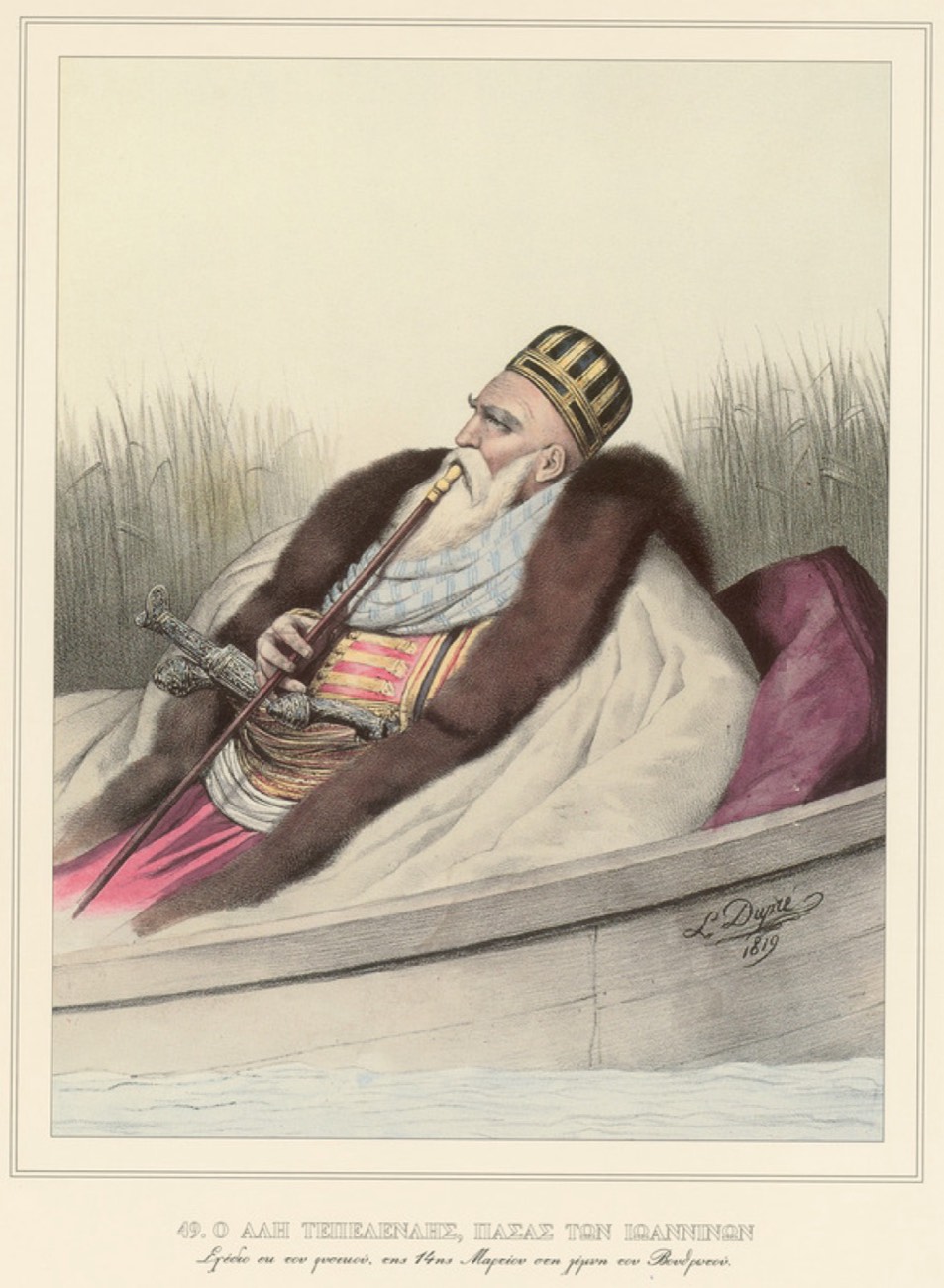
Stand on Parga's castle walls at dusk and look south-east towards the mountains, and you are looking towards Ioannina, the lakeside city that was once the capital of one of the most extraordinary and feared men the Balkans ever produced. For over three decades, Ali Pasha of Ioannina ruled a semi-independent domain that stretched from southern Albania to the Gulf of Corinth, and for a few turbulent years it swallowed Parga itself. His story is one of brigandage, brilliance, cruelty and courtly splendour, and it still colours how this whole coastline understands its own past.
From bandit's son to Ottoman power broker
Ali was born around 1740 in Tepelenë, in what is now southern Albania, into a family of local beys. When his father died, the young Ali and his mother turned to banditry to rebuild their fortunes, and he learned early the lessons of ambush, alliance and betrayal that would define his career. Through a mixture of military service to the Ottoman Sultan, ruthless suppression of rival brigands and outright extortion, he was appointed pasha of Ioannina in 1788.
From that base he extended his grip, formally or informally, over most of Epirus, southern Albania and parts of Thessaly and central Greece, ruling as a virtually independent monarch while nominally remaining a servant of the Ottoman state. He played the Sultan, Napoleonic France and Britain off against one another with real diplomatic skill, steadily enlarging his own domain.
A court that fascinated Europe
By the early 1800s, Ali's court in Ioannina had become a genuine curiosity for European travellers and diplomats. Its blend of Ottoman ceremony, Balkan intrigue and cosmopolitan intelligence drew visitors from across the continent. The most famous was a young Lord Byron, who visited in 1809 with his friend John Cam Hobhouse. Byron was struck by the contrast between the old man's courtly, almost grandfatherly manner and his reputation for extreme cruelty, an impression that fed directly into his poem "Childe Harold's Pilgrimage" and helped make Ioannina, and Epirus more broadly, known to English readers for the first time. Hobhouse's own account of the journey remains one of the richest surviving descriptions of Ali's palace and the daily rhythms of court life.
Souli and the price of defiance
Not everyone in Ali's path submitted quietly. The Souliotes, a fiercely independent Orthodox Christian community in the mountains south of Ioannina, resisted him for decades. Early campaigns in the late 1780s and early 1790s ended in humiliating defeats for Ali's forces. He returned in 1803 with a larger army, and after a prolonged siege the Souliotes were finally driven from their strongholds. Some who had accepted terms of safe passage were attacked, killed or enslaved once his troops took control. According to the enduring, tragic tradition associated with the village of Zalongo, a group of Souliote women chose to leap from a cliff with their children rather than be captured, a story that became one of the most potent, if partly legendary, symbols of resistance in the lead-up to the Greek War of Independence.
Parga: bought, not conquered
Parga held a special, stubborn place in this story. Long under Venetian rule, then passed between French, Russian-backed and British protection as Napoleonic-era Europe redrew the map, it was one of the few coastal towns in the region Ali never took by force, despite years of pressure and blockade. What decades of campaigning could not achieve, diplomacy eventually did. In 1817, Britain, then the protecting power over the Ionian Islands, signed a convention agreeing to hand Parga over to Ali in exchange for a substantial payment to its inhabitants.
The formal transfer took place in 1819, and it was a wrenching moment for the town. Rather than live under Ali's rule, most of the Parganiot population chose exile, gathering the bones of their ancestors from local cemeteries and sailing to British-held Corfu. Parga remained part of Ali's domain until his own downfall shattered his empire only a few years later.
The fall of the Lion
Ali's independence eventually proved intolerable to the Ottoman state. In 1820, Sultan Mahmud II declared him a rebel and sent a large army to remove him. Ioannina was besieged for around a year and a half while Ali held out in the fortified citadel of the city, known as Its Kale, overlooking Lake Pamvotis. Gradually his allies deserted him and his territory collapsed around him.
In January 1822, lured out under a promise of pardon, Ali withdrew to a monastery on the small island in the middle of the lake, still visible from the citadel today. There, on 24 January 1822, Ottoman officers cornered him. He refused to surrender without a fight, was shot, and beheaded; his head was sent to Constantinople as proof of the rebellion's end. The Pashalik of Ioannina, the improvised domain he had spent a lifetime building, disintegrated within weeks, just as the wider Greek uprising against Ottoman rule was gathering pace.
Good to know
- Ioannina, the seat of Ali Pasha's power, lies around 100km from Parga, roughly an hour and a quarter by car via the Ioannina–Igoumenitsa road.
- In Ioannina, the citadel of Its Kale and the small island on Lake Pamvotis (reached by a short local boat crossing) are the places most closely tied to Ali's final days.
- Parga Castle itself, above the town, retains elements from successive rulers, including the brief Ottoman period under Ali; it is a gentle, atmospheric walk best done in the cooler light of early morning or evening.
- Cobbled paths and uneven stone at both the castle and the citadel make sturdy footwear sensible; buggies and wheelchairs will find sections difficult.
- Children generally enjoy the castle ramparts and the boat crossing to the island more than the historical detail, so pair a visit with the view and the walk rather than expecting a long history lesson to hold their attention.
- Spring and fine autumn days are the most comfortable times to explore either site, avoiding the height of summer heat.