
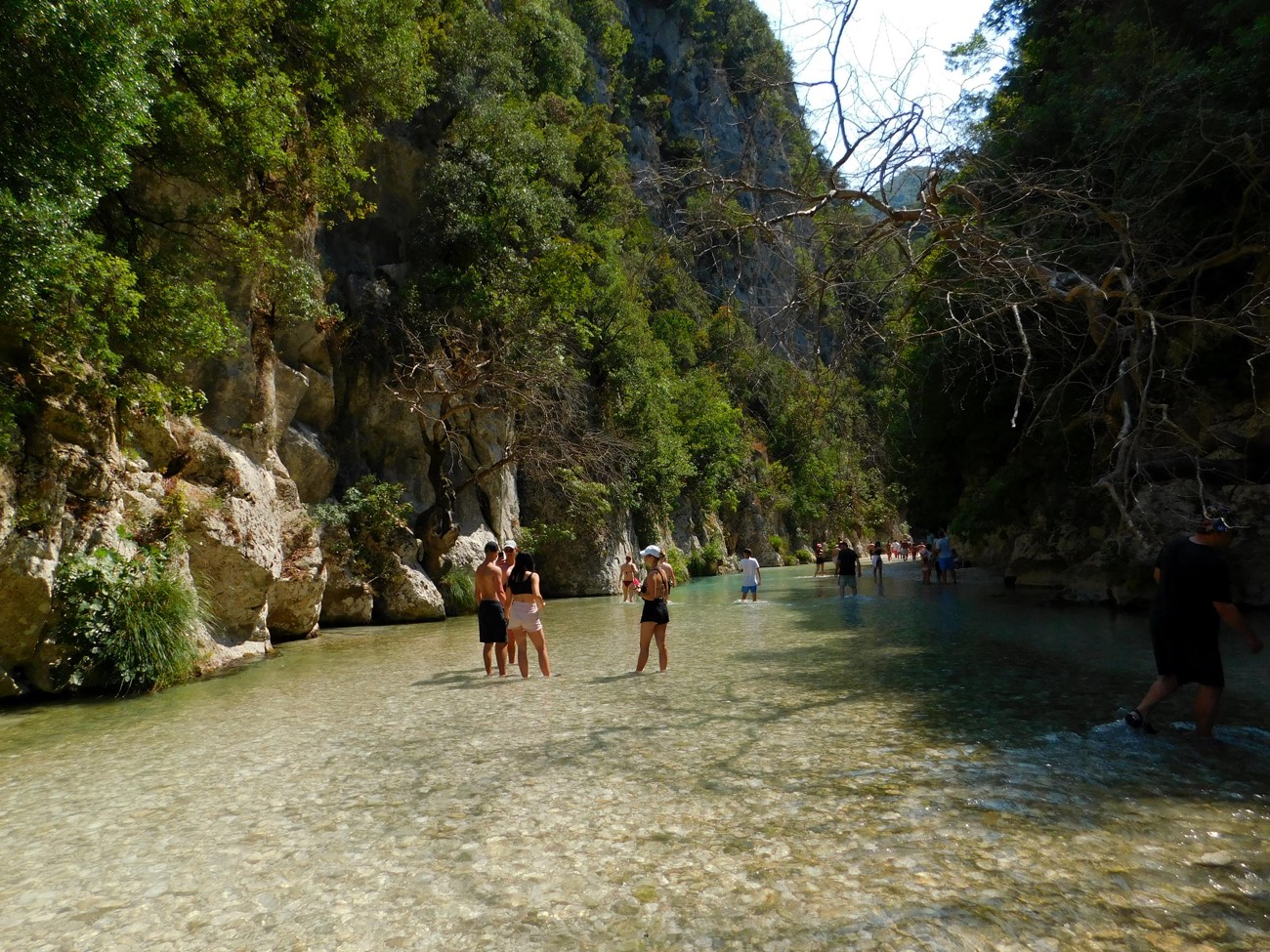
Not every river gets a starring role in the ancient imagination, but the Acheron did. The Greeks believed this modest, spring-fed waterway on the western edge of the Pindus mountains was one of the rivers of the underworld itself — a crossing point where souls were said to leave the world of the living behind. Today it flows through some of the prettiest countryside in Epirus, a short drive inland from Parga, and it has become one of the region's most rewarding half-day or full-day trips: part myth, part archaeology, part simple pleasure in cold, clean water.
A river woven into myth
In Greek mythology, the underworld was watered by several rivers, and the Acheron — sometimes translated as the "river of woe" — was counted among the most important. In the oldest tellings, this was where Charon the ferryman rowed the souls of the newly dead across the water, provided they carried the fare: a single coin left with the body at burial. Roman poets writing later increasingly shifted this famous crossing to the river Styx instead, so the two rivers share the myth depending on which ancient author you read. It is worth being clear that all of this belongs firmly to legend rather than history — but it is legend with an unusually long memory, still shaping how visitors experience the valley today.
The Necromanteion: Oracle of the Dead
Not far from where the Acheron nears the sea, on a low hill by the village of Mesopotamos, stand the remains of the Necromanteion — literally the "oracle of the dead". Ancient writers describe this as the point where the Acheron converged with other rivers associated with the underworld, and pilgrims are said to have travelled here believing it was a genuine threshold to Hades' realm, undergoing purification rituals before being led through dark, maze-like stone corridors to an inner chamber.
The ruins were excavated in the late 1950s and 1960s by the Greek archaeologist who identified the site with the oracle described in ancient sources, and who interpreted bronze fittings found in the ruins as parts of a pulley or crane mechanism — evidence, he argued, that priests staged ghostly apparitions to convince visitors they were communing with the dead. That dramatic reading captured the public imagination, but it has since been challenged by other scholars: similar bronze fittings elsewhere have been re-identified as parts of ancient catapults, and some archaeologists now argue the building may have been a fortified farmhouse or watchtower from the Hellenistic period rather than a religious sanctuary at all. The true identity and purpose of the site remain genuinely disputed among specialists. Even so, the ruins are open to the public and make for an atmospheric, thought-provoking stop, especially combined with a river visit on the same day.
Getting there from Parga
The springs and gorge near Glyki, generally considered the best starting point for river activities, lie roughly 20 to 25 kilometres from Parga — about 30 to 40 minutes by car along the road toward Preveza. The Necromanteion is a little closer, around 20 kilometres away, near Mesopotamos. Both can realistically be combined in a single day trip. Guided coach or minivan excursions run regularly from Parga, typically departing mid-morning and returning by mid-afternoon, and are a straightforward option if you would rather not navigate the mountain roads yourself. Self-driving gives you more flexibility over timing and lets you linger at the springs once the day-trip crowds have thinned.
Walking the springs
From the car park near Glyki, it is only about a ten-minute walk through shaded plane-tree woodland to reach the springs, where the Acheron emerges startlingly clear and blue-green from beneath the mountain. From there, a path continues alongside the river for as far as you fancy wading and clambering; going all the way to the far end and back can take a couple of hours, so pace yourself according to footwear and energy. The riverbed is stony and can be slippery, so grippy sandals or trainers are worth packing, and the water stays cold even in high summer. Spring and early summer bring the fullest, most dramatic flow; by August, levels drop and much of the riverbed becomes easy to walk, which suits families with smaller children particularly well. Supervise little ones closely near the deeper pools.
Rafting and other river adventures
The Acheron's gentle character — rarely more than an easy grade of white water — has made it one of Greece's most approachable rivers for organised rafting, and local operators run short, guided trips suitable for complete beginners and most families. Minimum ages vary by operator, but children from around seven or eight years old upward are typically welcomed, with full safety equipment supplied; do check specific age policies in advance if travelling with young children. Kayaking, canoeing and simple river trekking are widely available alongside rafting, and some outfits also offer horse riding nearby. Mornings tend to be calmer and cooler, and a wetsuit or spare change of clothes is sensible whatever the season, since the water temperature rarely feels tropical.
Good to know
- Distance from Parga: around 20–25 km to the springs near Glyki (roughly 30–40 minutes' drive); around 20 km to the Necromanteion.
- Both sites can be combined in one day, especially with an early start.
- Wear sturdy, grippy footwear for the riverbed — it is stony and can be slippery.
- The water is cold year-round; bring a towel and dry clothes even in midsummer.
- Best visited April to October; August brings the lowest, calmest water for wading and families.
- Guided rafting trips typically welcome children from around seven or eight years old, with equipment and guides provided — ages vary by operator, so check ahead.
- Remember that the underworld connection is mythology, not historical fact — enjoy it as the ancients' storytelling rather than record, and note that even the Necromanteion's true identity is debated among archaeologists.