
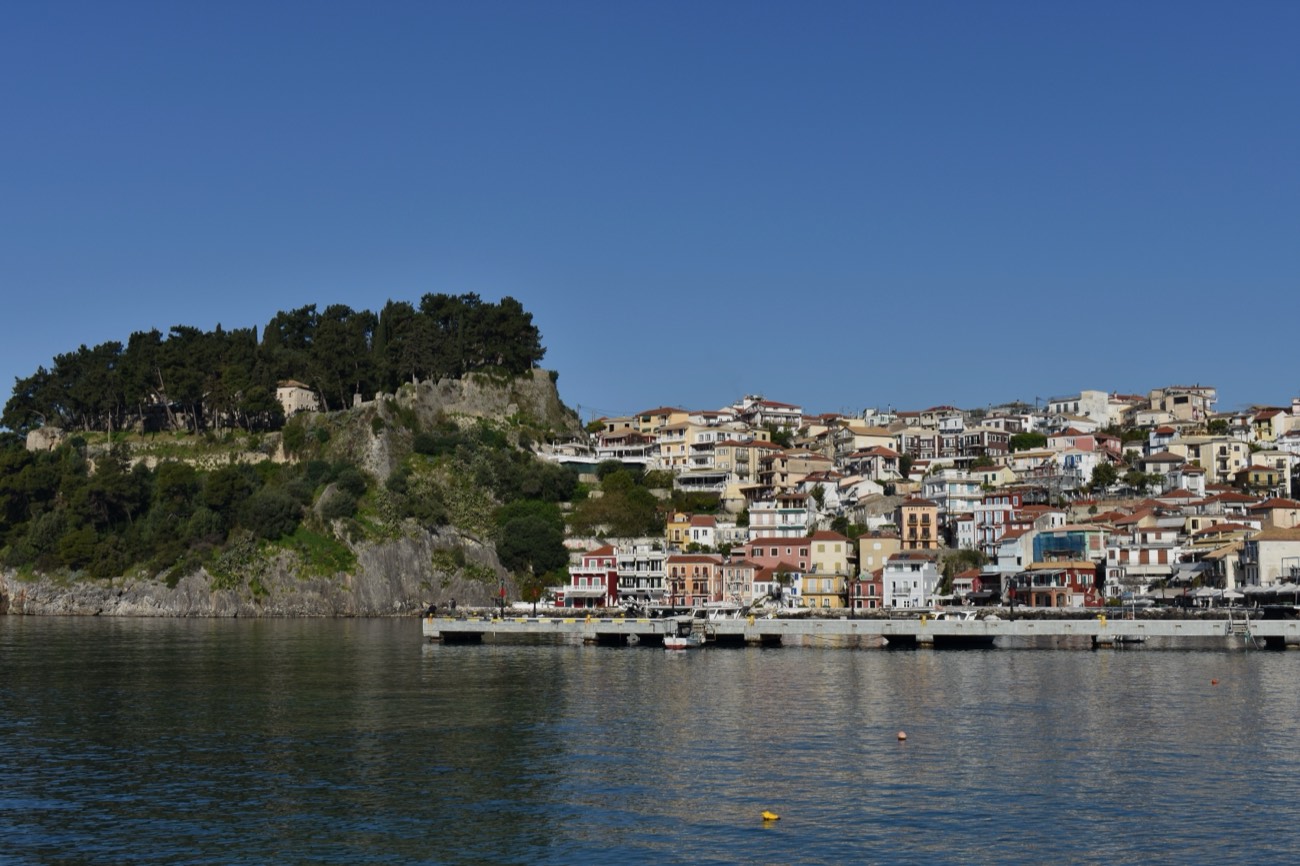
Parga wears its history lightly. You may come for the amphitheatre of pastel houses tumbling down to a turquoise bay, and never guess that this small Epirot town was once a coveted prize, fought over by empires and finally lost in one of the most poignant episodes of the Greek nineteenth century. Yet the story is written into the stones above your head, in the Venetian castle on the headland and in a bay that has watched Byzantines, Venetians, Frenchmen, Russians and Britons come and go.
A frontier town between mountains and sea
Parga sits on the Ionian coast of Epirus, on the Greek mainland, looking across the water to the islands of Paxos and Antipaxos. That position shaped everything that followed: a sheltered natural harbour on the mainland, within sight of the islands, always a little apart from the hinterland behind it.
The town first appears in written records in 1318. During the Epirote rebellion of 1338 to 1339 it stayed loyal to the Byzantine emperor Andronikos III. Its people learned early to be shrewd — too small to defend themselves alone, too useful to be left in peace.
Under the lion of Saint Mark
In 1401 the townsfolk, weary of a local overlord they considered a tyrant, placed themselves under the protection of Venice. For nearly four centuries Parga was governed as a mainland outpost of Venetian Corfu, administered by a castellan appointed from the island.
Prosperity followed. As one of the few Christian, Venetian-held footholds on an otherwise Ottoman shore, Parga thrived as a conduit between Ottoman-ruled Greece and the Venetian world, its wealth resting largely on its famous olive groves. The castle you climb today stands on foundations first laid in the eleventh century; the Venetians rebuilt it more than once over the following centuries, and the fortress you see now dates largely from the late eighteenth century, its final works completed around 1808. Apart from brief Ottoman interludes, the winged lion of Saint Mark flew over Parga until the Republic of Venice itself fell in 1797.
A pawn in the Napoleonic wars
The fall of Venice set Parga adrift in the great-power currents of the Napoleonic age. French revolutionary troops arrived in 1797. Under the Treaty of Constantinople in 1800 the town passed nominally to Ottoman suzerainty with a special protected status, while the Ionian islands became the Russian-backed Septinsular Republic. In 1807, by the Treaty of Tilsit, the French returned. Then in 1814 the Pargans themselves rose up, expelled the French garrison and invited in the British, who by then held the Ionian islands.
Through every one of these changes the townspeople clung to a single hope: to stay out of the hands of Ali Pasha, the ambitious and ruthless Ottoman governor of Ioannina, whose domain now pressed in on them from every landward side.
The sale of 1819 and the Exodus
It was not to be. By 1817 Britain, anxious to keep the powerful Ali Pasha on friendly terms, had resolved to hand Parga over to him. The transfer was arranged by the British Lord High Commissioner of the Ionian Islands, Sir Thomas Maitland, with Ali Pasha to pay £150,000 in compensation intended for the inhabitants — a valuation the Pargans always disputed.
They refused to live under Ali Pasha, and what they did next has never been forgotten. On Good Friday of 1819, as the church bells tolled, they opened the graves of their ancestors, gathered the bones and burned them on a great pyre so that no enemy could ever desecrate them. Carrying the ashes, their holy icons and a handful of their native soil, nearly the whole population — several thousand souls — crossed to Corfu and Paxos, then under British protection, leaving empty houses and silent churches behind them.
The compensation, when it came, fell far short of what had been lost. The affair became a scandal in London — debated in Parliament and denounced by Lord Byron — and a byword across Europe for a bargain struck at a people's expense. For the Pargans, it was simply exile.
Reading the history today
The exiles' descendants drifted back over the following century, and Parga was finally united with Greece in 1913, after the Balkan Wars. Today it is one of the loveliest towns on the Epirot coast, and its past is wonderfully legible on foot.
Climb to the Venetian castle on the headland — entry is free, the walk up through the old town is steep but short, and the view over the red roofs, the little chapel on the islet of Panagia in the bay and the long sweep of the main beach is among the finest in town. Go in the golden hour before sunset, when the light turns the whole harbour amber.
Getting there is easiest by air into Aktion, the airport serving Preveza, roughly 65 km and about an hour's drive along the coast road; the airport at Ioannina lies a little over 100 km away through the mountains. Regional buses connect Parga with Preveza and Igoumenitsa, each within roughly one to two hours, and Igoumenitsa's ferry port links onward to Corfu and Italy. There is no railway. The old town's stepped lanes are full of character but unfriendly to wheelchairs and heavily laden pushchairs, whereas the seafront and the main beaches are far more accessible.
Good to know
- Best time to visit: late May to June and September bring a warm sea and thinner crowds; July and August are the busiest and hottest months.
- The castle is free and open-air — wear proper shoes for the climb and carry water in summer.
- Families are well served: sheltered, shallow beaches and short boat trips to Paxos, Antipaxos and the nearby sea caves make gentle days out with children.
- Easter carries special weight here — Good Friday is bound up with the memory of the Exodus, and the celebrations are deeply felt.
- The town is walkable but hilly, and smaller places may prefer cash.